Skip to content
Back to Portfolio
AISelf-study, 2024 – 2026

AI-Augmented Development Pipeline

RoleSoftware Developer & Automation Designer
StatusCompleted
Last Updated2026-03-22
AI Coding AgentsTypeScriptPrompt ArchitectureStatic AnalysisCode Review
Open Live Simulator
NOTE ON PENDING ASSETS:Automated empirical speed comparison report (agent-assisted vs. manual commits) is currently running benchmarks.

Live Build

Working System & Interface Capture
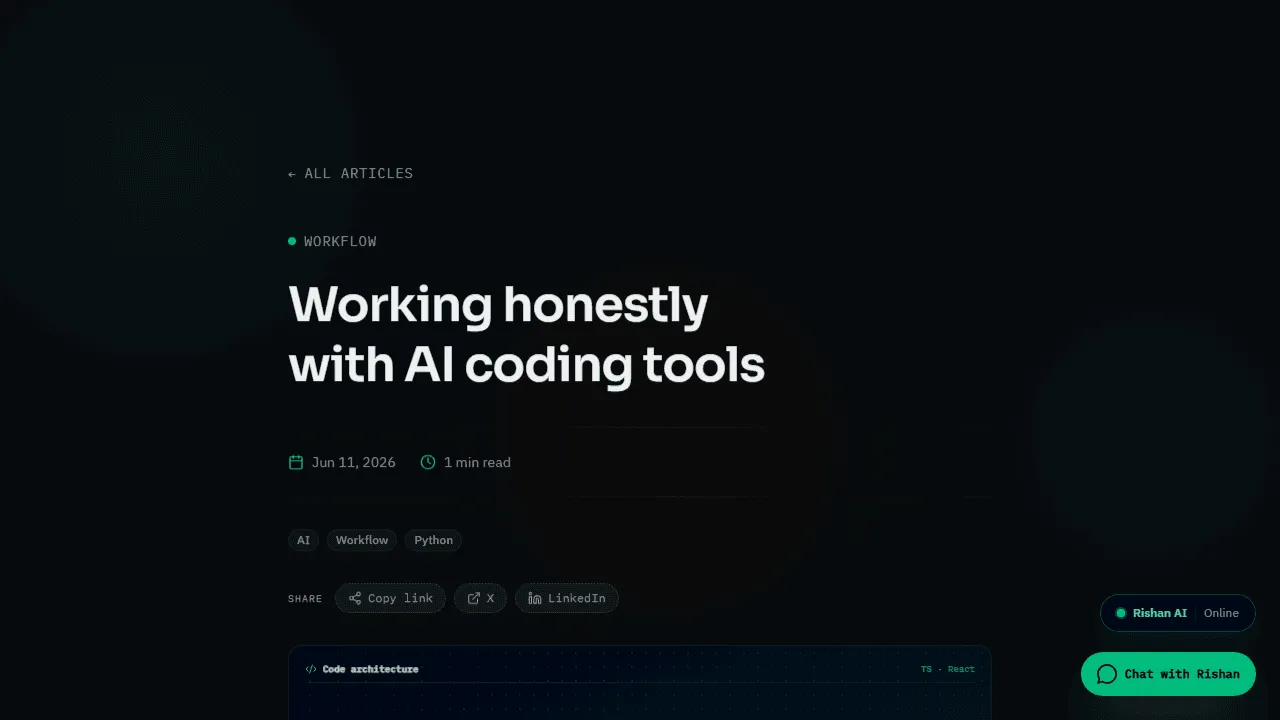
Dark article view titled Working honestly with AI coding tools showing workflow category badge, reading time metadata, tag pills, social share buttons, and a code architecture preview panel
Bench Build Documentation · Work In ProgressAI-Augmented Development Pipeline

Topology

System Schematic & Architecture

AI Engineering Pipeline · Google Gemini 2.5 Flash
Grounded Context · Zero Hallucination
01. INGESTIONCLI / Client UI

Prompt sanitized via Zod

02. RATE LIMITToken Bucket

60 req/min per IP firewall

03. GROUNDINGEngineering RAG

Verified records & syllabus

04. OUTPUTSanitized Stream

Direct to React 19 Client

Model: Gemini-2.5-Flash (Temp: 0.2, TopP: 0.95)Latency < 380ms TTFT

Overview

An architectural framework and code review protocol that harnesses AI coding agents as high-velocity accelerators while strictly preventing silent defects, hallucinated APIs, and security vulnerabilities.

The Problem

Unreviewed AI-generated code frequently produces plausible-looking bugs, deprecated library methods, security vulnerabilities, and messy architectures that fail in production.

The Solution

Engineered a rigorous protocol: modular schema-first prompt contracts, mandatory human line-by-line inspection, automated AST type verification, and comprehensive regression testing before committing.

Key Features

Contract-first prompt design referencing exact schema definitions and Zod validations
Multi-agent review pattern: drafting agent followed by specialized lint and security review agents
Automated pre-commit hooks enforcing strict ESLint, Prettier, and TypeScript compilation
Clear demarcation between machine scaffolding and human architectural oversight

Engineering Obstacles

Challenges Overcome

Preventing agents from re-introducing outdated patterns or unauthorized external libraries.

Maintaining consistent component semantics across complex multi-page applications.

Verification & Impact

Results & Verification

Faster initial UI scaffolding and boilerplate construction with agent assistance.

A strict review protocol keeping unreviewed or hallucinated code out of production branches.

Roadmap & Future Extensions

Future Planned Iterations

01.Open-source the review checklist as an interactive web developer guideline
02.Implement automated prompt evaluation harnesses for local code models